



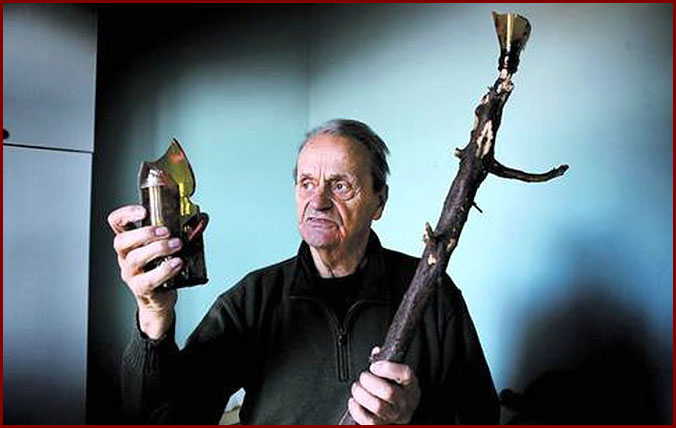
Albanian terrorists impaled him on a stake on May 1, 1985. The truth was hidden for 15 years. Glas is the first to publish the complete “sequence of events” about Đorđe Martinović. When he became known to the world public, the first report was published on May 4, 1985, in Politika. It read: “An employee of the JNA Home in Gnjilane, Đorđe Martinović, was impaled on a stake on May 1 on his field, Jaruga, two kilometers from Gnjilane. This atrocity was committed by Albanian terrorists.”
That news broke like a bolt from the blue in the then-tense reality of Kosovo and Yugoslavia. Today it can freely be said that it was the initial spark for many later events in Kosovo and Metohija and throughout Yugoslavia—and, in a way, even for the famous Eighth Session a year and a half later.
On the occasion of the news of Đorđe Martinović’s death, the editorial board of Glasnik is publishing details that have never been revealed before—details that largely shed light on the truth that had until now been hidden from the public.
The facts are as follows: On May 1, at 1 p.m., Albanian terrorists ambushed Đorđe Martinović in his field and impaled him on a stake. There was a bottle placed on the tip of the stake, which remained inside the victim’s abdomen. With his last strength, Đorđe managed to reach the road and was taken to the hospital in Priština, where he underwent emergency surgery.
In his critical condition, after news of the incident had already leaked to the public, Colonel Novak Ivanović, head of the JNA Home in Gnjilane, came to visit Đorđe Martinović and forced him to “confess” that he had impaled himself with the bottle because he was a homosexual. A year later, in an interview for the magazine Intervju, Novak Ivanović admitted that he had been ordered to do this by a certain General Stojanović. Afterward, Colonel Ivanović was reassigned and transferred to Zrenjanin.
From Priština, Đorđe Martinović was transferred to the Military Medical Academy (VMA) in Belgrade, where five prominent doctors, led by Dr. Ćeramilac, signed a diagnosis stating that self-infliction of such an injury was impossible. A second expert evaluation was requested, and medical professionals confirmed again that self-infliction was not possible. Then, a so-called “super-expert” opinion was sought from Slovenian academician Janez Malčinski of Ljubljana, who officially wrote that self-infliction was both possible and not possible.
Finally, Đorđe Martinović was transferred to London to Dr. Peter Halli, who operated on him twice and publicly declared that self-infliction was impossible. As a result, Dr. Halli received a letter from Dr. Malčinski threatening him “for interfering in the internal affairs of Yugoslavia.”
The entire case, it can now be said, was overseen by then–Federal Secretary of the Interior of the SFRY, Stane Dolanc. It is remembered that in 1987, during a broadcast on Ljubljana Television, Dolanc stated: “The case of Đorđe Martinović is closed. My police determined that he injured himself, and there will be no trial. Đorđe is the first Serbian samurai who committed hara-kiri on himself,” he said with a wide smile.
It can also now be revealed that the Federal Public Prosecutor, Miloš Bakić, among other things, was awarded a high decoration for his handling of the Martinović investigation. Members of the judiciary, Vukašin Trumpić and Gradimir Popović, visited the gravely ill Martinović at the Military Medical Academy (VMA) and coerced him into signing a confession, in the presence of the police. All of this was permitted by General Vladimir Vojvodić, then head of the VMA in Belgrade, while his assistant, Srđan Krstinić—later an admiral in Franjo’s army—insisted that Martinović be expelled from the hospital.
This was testified to by Dr. Stanislav Nikić, then head of Neuropsychiatry at the VMA. Admiral Branko Mamula reportedly remained silent in response to a letter and plea from Dobrica Ćosić asking that the case be clarified. General Milan Daljević from the SSNO Directorate claimed that the army had nothing to do with the case. General Petar Gračanin, who succeeded Dolanc as head of the SFRY Interior Ministry, demanded that the Martinović case be closed.
In 1990, the Second Municipal Court in Belgrade, acting on Đorđe Martinović’s lawsuit, ruled that the state was obligated to pay him approximately 100,000 German marks in damages for the insults and deliberate concealment of the truth. However, even after so many years, the verdict has never been enforced, and neither Martinović nor his family (his wife, three sons, daughter, and ten grandchildren) have ever received any compensation.
Milorad Bajić, the author and director of the films about the Martinović case, Fear of the Truth and We Accuse, emphasizes that the films were never shown on Radio Television of Serbia “because of the ban imposed by RTS executives Dušan Mitević and Milorad Vučelić.” Although Bajić was invited several times to deliver the films, their broadcast was always canceled at the last moment.
Every year on May 1, Bajić writes an open letter to Slobodan Milošević, reminding him that even after 15 years, the state has not officially discredited the lies about Martinović—despite the claims of both domestic and international experts that, from a medical standpoint, it was impossible for a man to inflict such a severe injury upon himself.
“The films are not nationally biased and do not deal with Albanian separatism,” Bajić explains, “but rather with the monstrous pressures and lies used by the state at the time to convince us that everything in Kosovo was supposedly fine. I want the public to understand that by concealing the truth and manipulating the media, problems can only deepen, not be solved. Did this distorted reality about Kosovo help the Serbs or the Albanians?” asks Bajić, who, on behalf of the Martinović family, invited all justice- and truth-loving people to attend today’s funeral of the Kosovo martyr.
All those who took part in concealing the truth about the suffering of Đorđe Martinović—a man once regarded as a metaphor for the Serbian suffering in Kosovo—all who participated in the media mystification of his tragedy, can now breathe a sigh of relief. Đorđe is dead; some of them are also gone. Whether those still living are haunted by guilt for what they did is known only to them.
(Based on articles published in the daily newspapers Glas javnosti and Danas on Saturday, September 9, 2000.)
Today: The Funeral of Kosovo Martyr Đorđe Martinović — Victim of Separatism and Misguided Policy
Kruševac, September 9, 2000 – Today at 1 p.m., in the village of Čitluk near Kruševac, Đorđe Martinović (1928) will be buried in the presence of his closest family: his wife Jagodinka, sons Srećko, Dragan, and Gradimir, daughter Olga, and ten grandchildren.
Đorđe Martinović (who passed away last Wednesday) was a man who became a symbol of suffering, truth concealment, and media manipulation. Martinović was the victim of a monstrous crime committed against him on May 1, 1985, by Albanian separatists in Kosovo. In order to intensify the exodus of Kosovo Serbs and spread fear, they impaled Đorđe with a half-liter bottle mounted on a stake in his field, Jaruga, near Gnjilane.
Književne novine, No. 999 – November 1999