



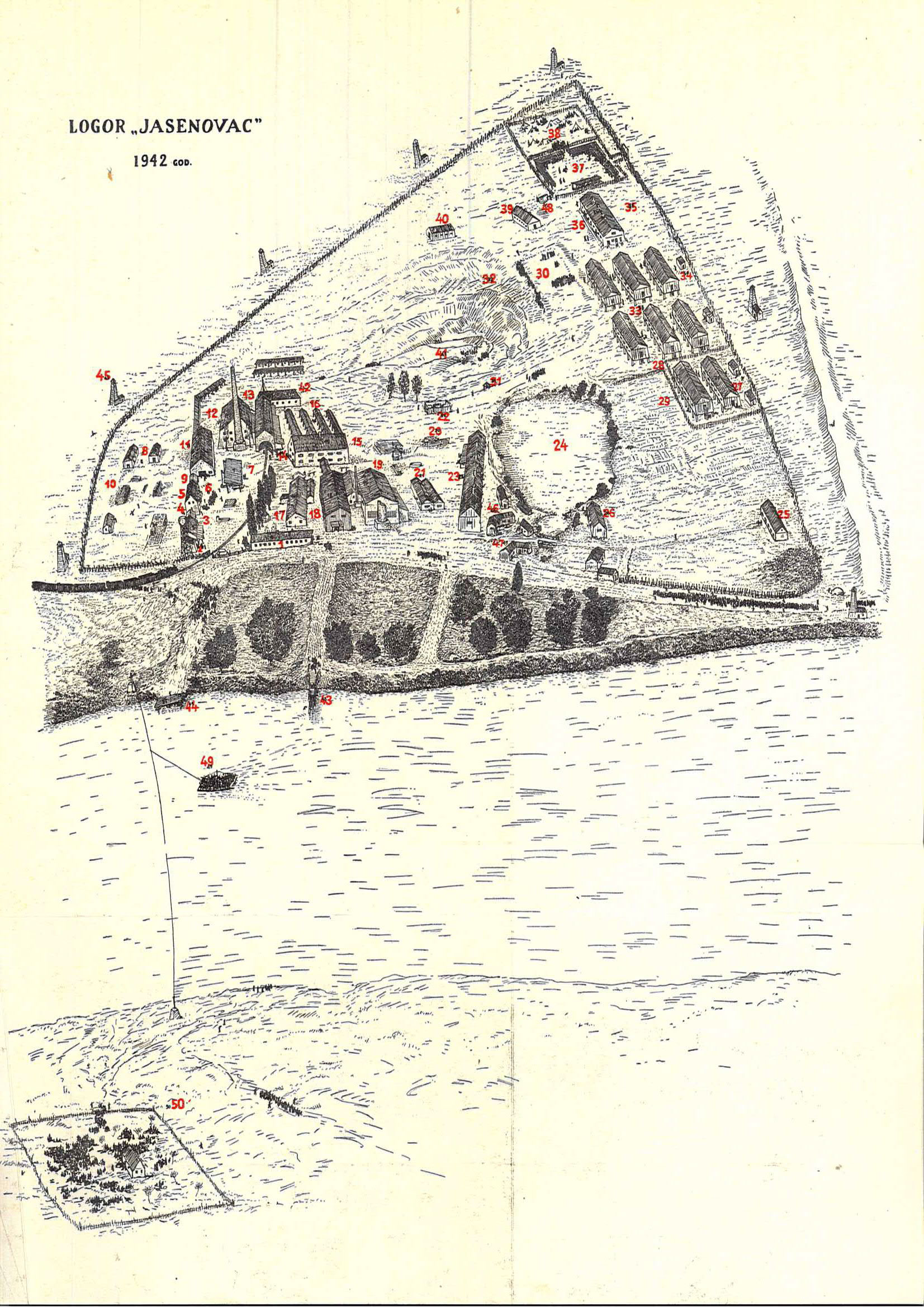
Appearance and Location of the Camp
The Jasenovac Camp was a death camp located near the town of the same name in the so-called Independent State of Croatia during World War II. It was established in August 1941 and destroyed by the Ustaše in April 1945.
The camp was built between August 1941 and February 1942. Most of it was situated in the town of Jasenovac, about 100 kilometers southeast of Zagreb. Camps I and II were located in the villages of Bročice and Krapje, but they were soon dismantled due to frequent flooding. Prisoners were transferred to the Ciglana Camp (Jasenovac III), which was the largest and included a crematorium. Executions were carried out in Donja Gradina, on the opposite side of the Sava River. A children’s camp was located in Sisak, and a women’s camp in Stara Gradiška, southeast of Jasenovac, although women and children were also held in Jasenovac itself.
The system of concentration camps known as Jasenovac was designed in exile by Vjekoslav “Maks” Luburić, who also served as its first commander.
The first administrator of the camp was former priest Fra Miroslav Majstorović, and later Dinko Šakić.
Dinko Šakić belonged to the group of “officers” who carried out the most monstrous crimes in Jasenovac. This group of “officers” also included Mima Pavićević, Modrić, Matković, Naletić, Šarić, Đerek, Sablić, Mihaljević, Josip Matija, and Petar Brzica.
The Jasenovac concentration camp consisted of several camps established within short time intervals, at varying distances from the town of Jasenovac itself. The Ustaše killed or relocated the entire local population and stationed a permanent Ustaše garrison in the town. The camp itself was a system of five main camps and several smaller camps and execution sites, covering a total area of about 210 square kilometers near the confluence of the Una and Sava rivers.
The camps were:
Camp I – Bročice
Camp II – Krapje
Camp III – Ciglana
Camp IV – Kožara
Camp V – Stara Gradiška
Additional nearby areas with execution sites included: Gradina, Jablanac, Uštice, Mlaka, Dubica (the lime kiln), and Granik (on the Sava River).
Preparatory work for establishing the new camp began no later than July 24, 1941, when the Directorate for Land Reclamation and Regulation Works ordered timber “for the construction of wooden barracks in Jasenovac.” Although the name Jasenovac was mentioned, the first detainees were brought to Camp I, near the village of Krapje, and to Camp II, located near the village of Bročice.
The camp was founded between August 15 and 21, 1941, and the first prisoners arrived on August 20–21 to build the barracks in Camp I, Bročice. On August 23, Croatian newspapers reported the establishment of a labor camp in Jasenovac for the construction of embankments on the Lonja and Trebež rivers in order to drain the Lonja marshes.
These first two camps were soon dismantled due to frequent flooding from the Veliki Strug River, which made prisoner labor and camp life impossible. The surviving inmates were transferred to the newly established Camp III — Ciglana, located near the town of Jasenovac on the Sava River, where an industrial complex already existed. Alongside this largest and functionally central camp, other sections were gradually established: the Kožara labor group, founded in 1942 in the town of Jasenovac itself; the Stara Gradiška camp, the second largest, located within a former prison facility; and camp farms in Mlaka, Jablanac, Gređani, Bistrica, and Feričanci.
This unified camp complex, organized after the model of concentration camps of the Third Reich, officially bore the name “Ustaša Defense – Command of the Collection Camps Jasenovac.” It was under the command of the Ustaša Surveillance Service (UNS), specifically its Office III of the Ustaša Defense, whose role was the establishment, organization, administration, and security of the camps.
The Jasenovac concentration camp was the first systematically constructed camp complex on the territory of the Independent State of Croatia, the only one that operated continuously throughout its entire existence, and the largest in terms of area, the number of prisoners who passed through it, and the number of victims who perished there. It was a multi-purpose camp, but above all, a death camp. It served as an execution site for the majority of those who entered it and did not fit into the concept of “racial purity” (primarily Serbs, but also Jews and Roma), as well as for opponents of the Ustaša regime and members of their families, regardless of national or racial background. Not only men were sent there, but also women and children from all parts of the Independent State of Croatia.
Legend to the Large Map “Jasenovac Camp”
- Guardhouse of the Ustaša “officers’” quarters — “Corridor of Mallets”
- Bell tower
- Torture chamber – prison and residence of torturers
- Shed for looted belongings
- Command headquarters; residence of Luburić – the “holy room”; residence of Ljubo Miloš – place of sadistic killings for pleasure; office of Begović
- Place for receiving newly arrived prisoners and selecting them for individual or mass executions, as well as for countless public tortures and killings
- “Assembly” area
- Warehouse, tinsmith workshop
- Garage
- Graveyard of metal equipment, vehicles, etc.
- Chain workshop
- Brickworks “Ring” kilns (ceramics) – for burning the living and the slaughtered
- “Tunnel of Death”
- Electricians’ workshop
- Construction group, carpentry
- Area for making raw clay bricks – site of many killings
- Ustaša “officers’” canteen and dining hall. Workshops: art ceramics, artistic metalwork, barbershop, etc.
- Sawmill
- Workshop building
- Site of many “roll calls” and executions
- Stable for tools and animal feed
- Latrines with open drainage – “Bajer” (41), from where water was pumped (31) into the “lake” (24) that prisoners drank from, contaminated with typhoid fever
- Bakery and food storage
- Ghostly lake
- Farm buildings, stables
- Slaughterhouse
- Hospital “B-I”
- Hospital “B-II” (“Human Trap”)
- Hospital quarters – for hospital staff
- Site of “roll calls” and “exemplary executions”
- Pump used to transfer contaminated water from “Bajer” to the “Lake” (24)
- Vegetation growing from the shallow graves of buried victims
- Camp grounds
- Latrines
- Playground for children who were later slaughtered
- Disinfection area; residence where children and their teacher lived
- “III-C”
- Gypsy camp – “Camp of Starvation and Death”
- Prisoners’ kitchen and storage
- “Rag Sorting” – for sorting Roma rags, later sent to textile factories
- “Bajer” – large crater from which clay was dug; site of mass killings by exhaustion
- Zyklon gas chamber – soap workshop
- Granik
- Ferry dock to Gradina
- Watchtowers
- Vrančić’s veterinary clinic
- Morgue
- Office “III-C”
- “St. Moloch” ferry
- “Haunted House” of Pero Vukić
Source: